
Flat Head Syndrome & Torticollis
Every Flat Spot deserves a closer look.

Head flattening and torticollis are common, and early, individualized physical therapy can make a meaningful difference. At BloomWell, we look beyond the flat spot to address underlying causes, ease your concerns, and help your baby thrive.
This is our specialty. You're in the right place.
understanding the basics
What Are Flat Heads & Torticollis?
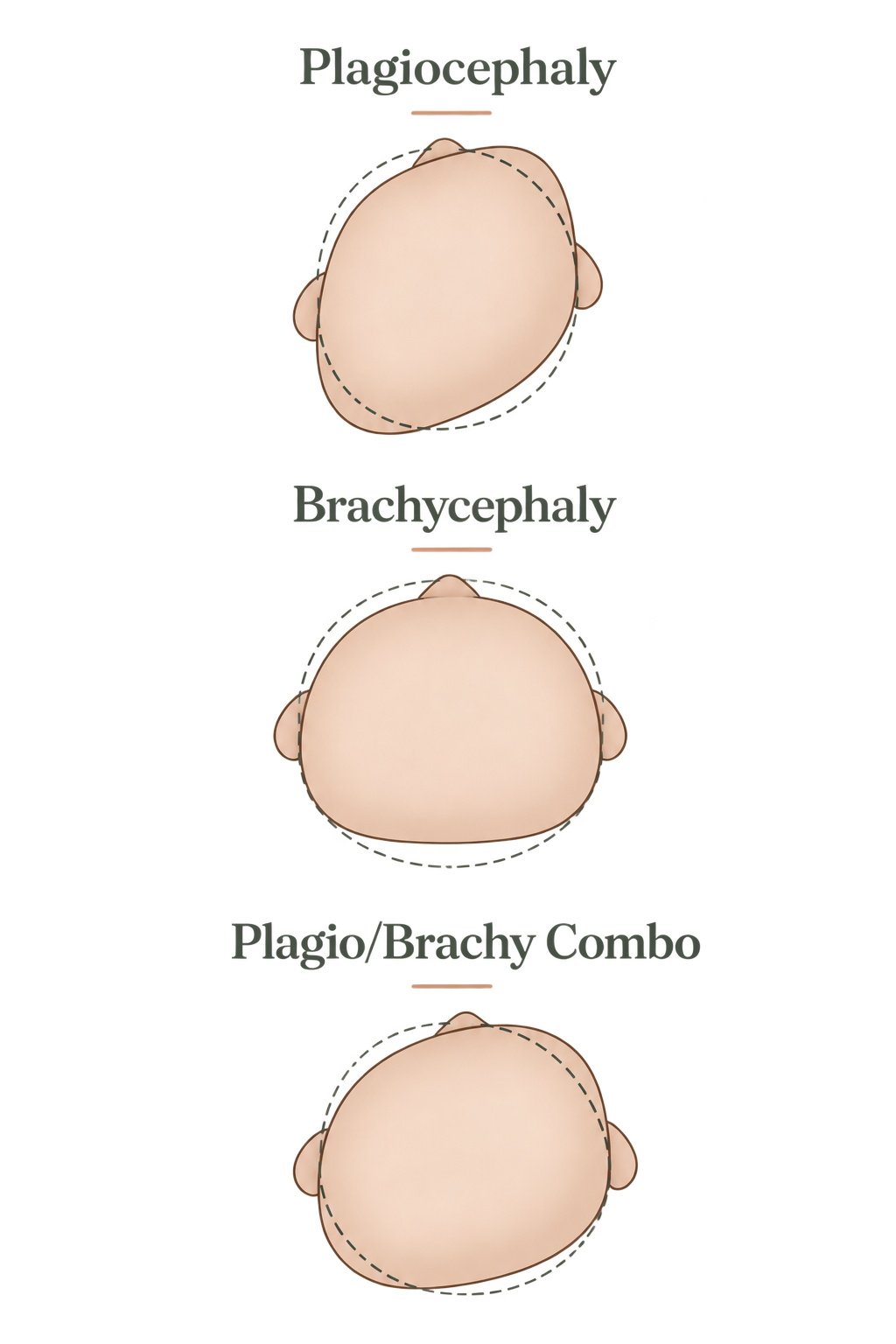
Flat head syndrome, including positional plagiocephaly and brachycephaly, occurs when repeated pressure causes flattening on one side or the back of a baby's head.
Torticollis occurs when neck muscle tightness or imbalance causes a baby to favor turning or tilting their head to one side. It can also affect the shoulders and trunk, contributing to body tension, asymmetrical movement, difficulty with tummy time, and challenges developing motor milestones.
These conditions often go hand in hand. Neck tightness can create a consistent turning preference, placing repeated pressure on one area of the head and contributing to flattening.
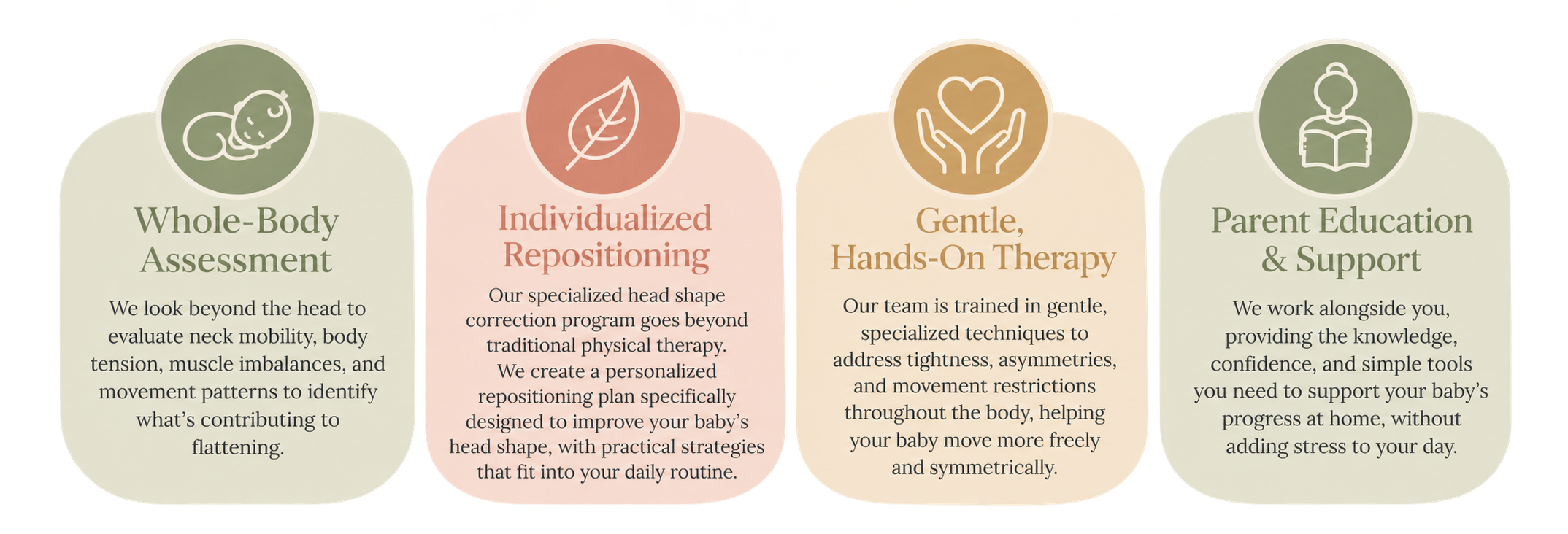
At BloomWell, we look beyond the flat spot to identify and address the underlying movement restrictions, body tension, and positional preferences affecting your baby's head shape and development.
By treating both the head flattening and its underlying causes, we work toward lasting correction, balanced movement, and healthy development.
why early intervention matters
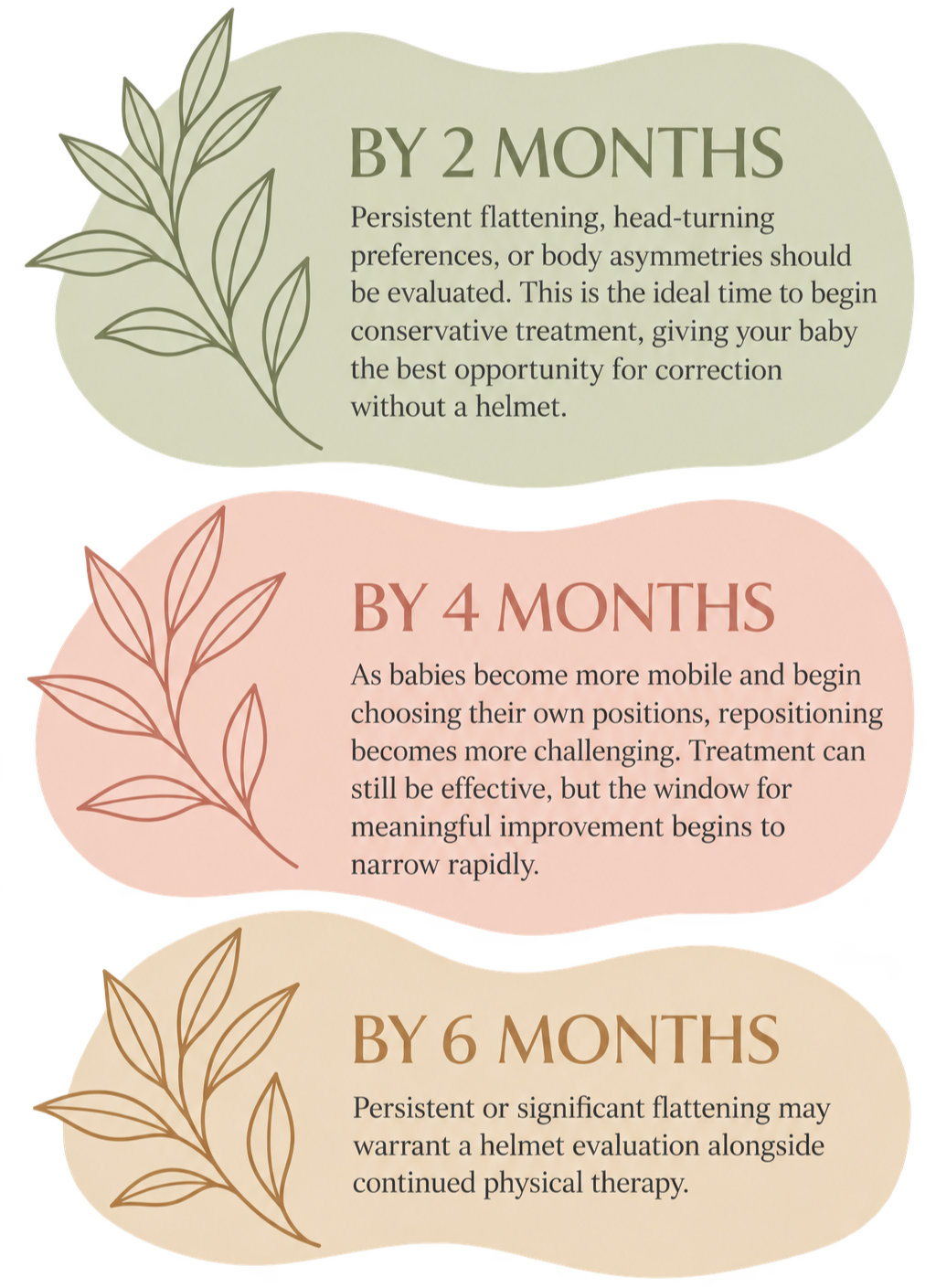
the first few months make a big difference.
During the first few months, your baby's skull is growing rapidly, and their limited mobility makes repositioning especially effective. This gives us a valuable window to improve head shape while addressing the underlying causes of flattening.
Early intervention gives us the best opportunity to improve head shape, address underlying restrictions, and support healthy, symmetrical development.
The Bloomwell difference
Real Families. Real Progress.
90%
of babies who completed their repositioning program at bloomwell did not require helmet therapy.
100% of babies showed improvement in head shape.
Ready to improve your baby’s head shape?
Still have questions?
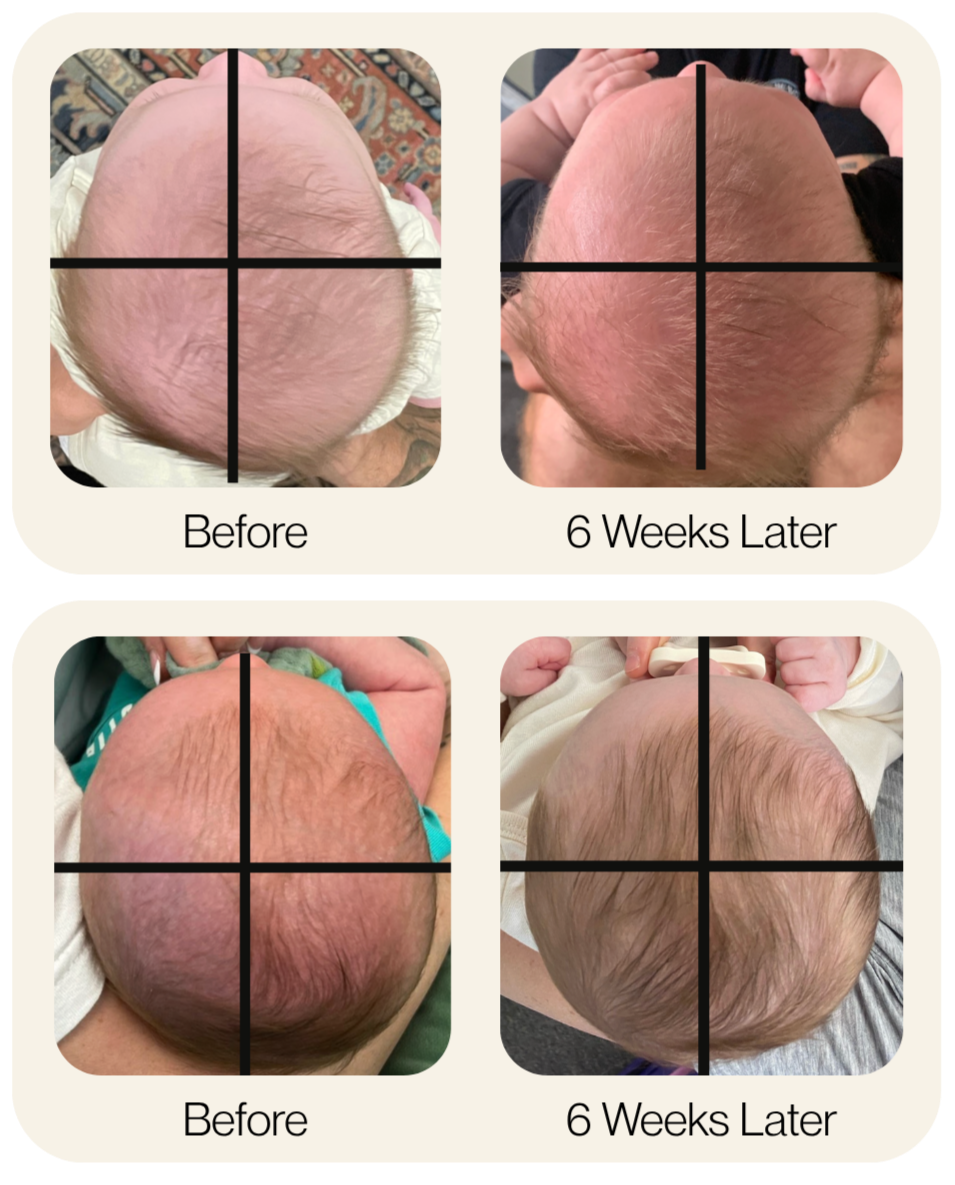
Based on 30 babies who completed BloomWell's individualized head shape repositioning program. Photos reflect actual BloomWell patients. Individual results vary, and helmet therapy may still be necessary. Physical therapy can complement helmet treatment when indicated.
Does my baby need a helmet if they have a flat head?
not always.
We're not anti-helmet. We're just upstream of needing one.
Helmet therapy can be an important and effective treatment for significant head flattening, but not every baby with a flat spot needs one. Many babies can achieve meaningful improvements without a helmet when conservative treatment begins early enough.
If your baby is under 4 months old and you've already been told they need a helmet, don't assume it's your only option. Early, specialized head shape correction may offer an opportunity to improve flattening without one.
Why Before 4 Months Matters
Whether a baby needs a helmet depends on several factors, including the severity of flattening, their age, and how consistently their individualized treatment plan is followed. One of the most important factors families can influence, however, is how early specialized physical therapy begins.
During the first few months, your baby's skull is growing rapidly, creating a valuable opportunity for improvement through individualized repositioning. As babies get older, repositioning becomes more challenging, and significant flattening may be harder to correct without a helmet.
Head flattening isn't an emergency, but when your goal is to avoid a helmet, time is of the essence.
We strongly encourage beginning treatment before 4 months of age.
At BloomWell, we specialize in conservative head shape correction, carefully monitor progress, and provide honest guidance about when helmet therapy may be beneficial. When a helmet is appropriate, we're happy to collaborate with your baby's care team.
Our priority is helping your baby achieve the best possible outcome, with or without a helmet.
-
Heidenreich, E., Johnson, R., & Sargent, B. (2018). Informing the update to the physical therapy management of congenital muscular torticollis evidence-based clinical practice guideline. Pediatric Physical Therapy, 30(3), 164–175.
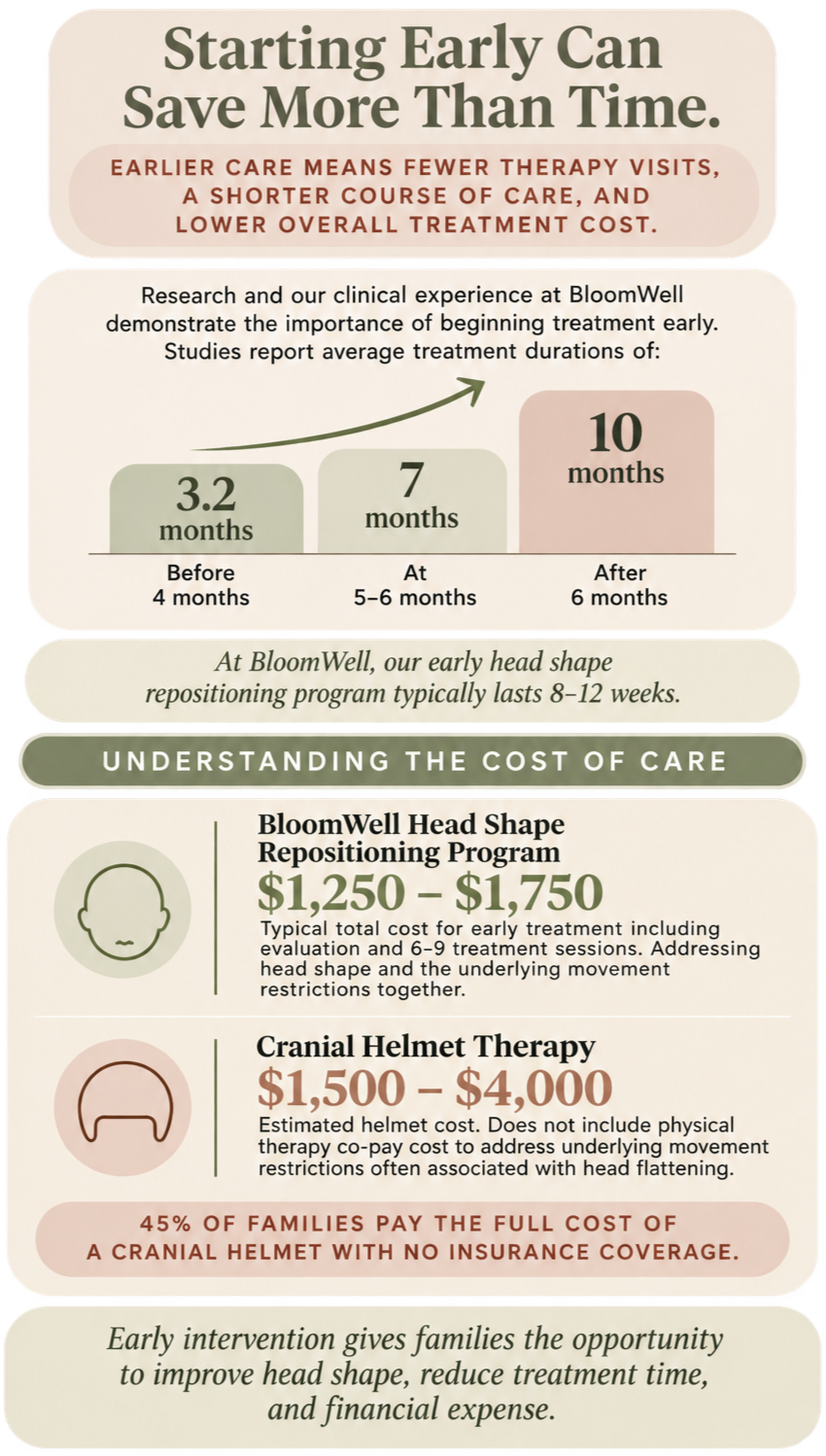
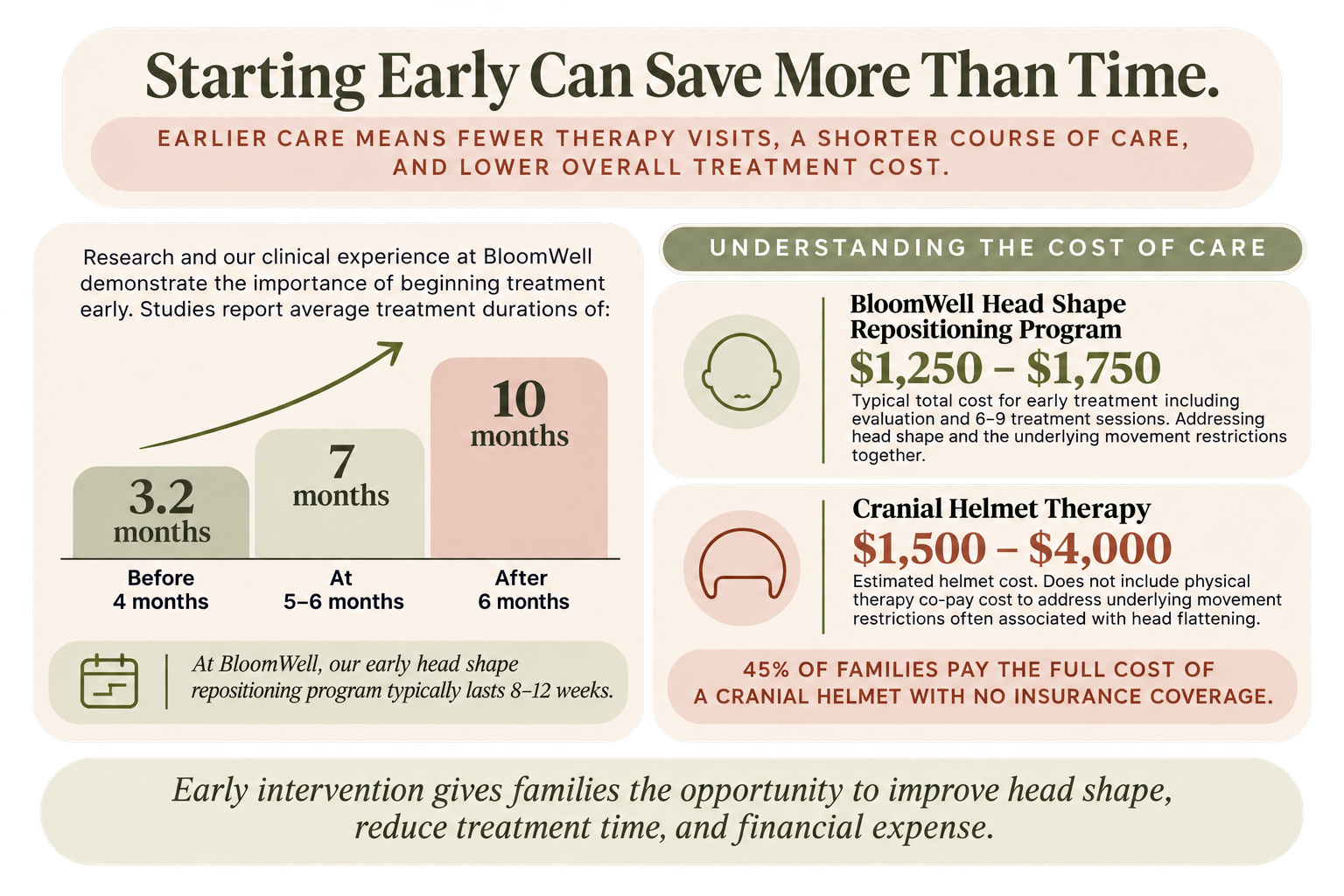
Yoo et al. (2012). Cited in the presentation for treatment duration by age of intervention. Full publication details not provided.
Cleveland Clinic Consult QD. (January 2023). Full article details not provided in the presentation.
Mendoza, P., & Holman, L. K. (2013, September 20). Torticollis.
Watt, A. J., Alabdulkarim, A., Lee, J., & Gilardino, M. S. (2022). Practical review of the cost of diagnosis and management of positional plagiocephaly. Plastic and Reconstructive Surgery Global Open, 10(5), e4328.
Jung, B. K., & Yun, I. S. (2020). Diagnosis and treatment of positional plagiocephaly. Archives of Craniofacial Surgery, 21(2), 80–86. https://doi.org/10.7181/acfs.2020.00059
Frequently Asked Questions
-
While mild flattening may improve naturally as babies grow and become more mobile, more significant head shape asymmetry will likely persist without targeted intervention.
When repeated pressure causes one area of the skull to flatten, continued skull and brain growth can contribute to compensatory changes in other areas, resulting in asymmetry or bulging in other areas of the skull shape.
This is why head shape correction involves more than simply reducing pressure on the flat spot. At BloomWell, we assess the entire head shape, addressing both flattening and areas of asymmetry while identifying the underlying movement restrictions that may be contributing to them.
Early intervention gives us the best opportunity to encourage more balanced, symmetrical head growth through individualized repositioning and physical therapy.
-
Laying your baby on their back isn't inherently the problem. It's often the underlying tightness, asymmetry, or positional preference that contributes to flattening.
Babies naturally turn their heads and vary their positions when laying on their backs, helping distribute pressure across different areas of the skull. However, when neck tightness, body tension, or movement asymmetries cause a baby to consistently favor one position, repeated pressure on the same area can lead to flattening.
You don't need to be afraid of laying your baby on their back! Back sleeping remains the safest position for sleep. Instead, pay attention to how your baby moves. If they consistently turn toward one side, struggle to turn the other way, or seem uncomfortable in certain positions, reach out early for support.
At BloomWell, we identify and address these underlying movement restrictions while teaching families safe ways to encourage balanced movement and healthy head shape development.
-
Tummy time is incredibly important for your baby's development, but tummy time alone isn't always enough to correct an existing flat spot.
Tummy time helps reduce pressure on the back of your baby's head while building strength and encouraging movement. However, if your baby has neck tightness, body asymmetries, or a strong positional preference, simply spending more time on their tummy won't necessarily address what's causing the flattening.
Additionally, once head shape asymmetry has developed, improving it often requires more specific repositioning strategies that account for both the flattened areas and any compensatory changes such as overgrowth, bulging, or asymmetrical alignment in skull shape.
At BloomWell, we combine individualized head shape repositioning with gentle, hands-on physical therapy to address the underlying movement restrictions and help encourage more symmetrical head growth.
Keep doing tummy time! Just know that if you're already noticing flattening, your baby may benefit from more targeted support.
-
Head flattening may appear to be a cosmetic concern, but its implications can extend beyond appearance, and the opportunity to correct head shape is time-sensitive.
Babies with positional head flattening frequently have associated neck tightness, torticollis, body tension, or asymmetrical movement patterns. These restrictions can influence how your baby moves and develops new motor skills.
Head shape asymmetry can also have lasting practical implications, including the fit of helmets and other headwear, particularly for sports or professions requiring protective equipment. Asymmetry may also become more noticeable with shorter hairstyles or hereditary hair loss.
More pronounced flattening can be accompanied by differences in ear positioning and facial symmetry. These changes deserve evaluation as they may potentially contribute to sinus, airway, or TMJ dysfunction.
Most importantly, the opportunity to reshape the skull through conservative treatment is limited. As skull growth slows and the bones become less responsive to external shaping, repositioning and helmet therapy become less effective. Once this period of rapid growth has passed, established head shape asymmetries can become long-lasting.
At BloomWell, we address both head shape and the underlying movement restrictions to encourage more symmetrical growth while your baby's skull is still rapidly developing.
Early intervention offers an opportunity to make meaningful changes that may not be possible later in life.
-
Flat head pillows are not recommended for infants because they pose a suffocation risk and have not been proven to safely or effectively correct head flattening.
The American Academy of Pediatrics recommends that babies sleep on their backs on a firm, flat surface without pillows, positioners, or other soft objects. This includes pillows marketed specifically for preventing or correcting flat spots.
These pillows can also encourage the exact thing we're trying to avoid: keeping your baby's head in one position for extended periods of time. Healthy head shape development benefits from natural movement and varied positioning, which help distribute pressure across different areas of the skull.
Additionally, these products do nothing to address underlying neck tightness, body asymmetries, or positional preferences that may be contributing to flattening.
At BloomWell, we teach families safe, individualized repositioning strategies that encourage natural movement, reduce prolonged pressure, and support more symmetrical head growth.
Skip the special pillows. Your baby needs freedom to move, safe sleep, and the right support when asymmetries are present.
-
It's not too late! While the first 4 months offer the greatest opportunity for early conservative head shape correction, babies can still make meaningful progress after this age.
During the first few months of life, your baby's skull is growing rapidly and is especially responsive to individualized repositioning. As babies get older, skull growth gradually slows, and correcting established flattening can become more challenging.
Babies who begin treatment later may require a longer course of care, and those with more significant flattening may benefit from a helmet evaluation alongside physical therapy.
Even if your baby is past the ideal window for early repositioning, physical therapy can still make a difference. At BloomWell, we assess your baby's head shape, neck mobility, body asymmetries, and developmental skills to determine the most appropriate treatment approach.
If you've noticed flattening, we encourage you to reach out rather than waiting to see if it improves. The earlier we can evaluate your baby, the more options we may have to support their head shape development.
-
Can my baby receive physical therapy while wearing a helmet?
Absolutely! Physical therapy and helmet therapy can work together to support your baby's head shape and overall development.
While a cranial helmet is designed to guide skull growth and improve head shape, it does not directly address the underlying neck tightness, body tension, or movement asymmetries that may have contributed to flattening in the first place.
If these restrictions remain untreated, your baby may continue to favor one side, have difficulty moving symmetrically, or develop compensatory movement patterns as they reach new milestones.
At BloomWell, we work alongside your baby's helmet provider to address these underlying restrictions through gentle, hands-on therapy, individualized exercises, and parent education.
Whether your baby is receiving helmet therapy or pursuing conservative head shape correction, addressing the underlying cause is an important part of comprehensive care.
-
Do I need a referral from my pediatrician to schedule an evaluation?
No! You do not need a pediatrician referral to get started with physical therapy at BloomWell.
California allows families to access physical therapy directly, meaning you can schedule an evaluation without waiting for a referral, subject to applicable state requirements.
If you've noticed head flattening, a consistent turning preference, neck tightness, or asymmetrical movement, you can reach out to our team right away.
We also value collaboration with your baby's pediatrician and are happy to share our evaluation findings and treatment recommendations to ensure everyone is working together to support your baby's progress.
Early intervention matters, and you don't have to wait for your baby's next well-child visit to take the first step.
Concerned About Your Baby's Head Shape or positional preference?
We're Here to Help.
You don't have to wait and wonder whether your baby's flat spot will improve on its own.
Whether you've noticed a small flat spot, a consistent turning preference, or more significant head shape asymmetry, our team at BloomWell can help you understand what's happening and what your baby needs.
Early evaluation gives your baby the best opportunity for meaningful improvement through gentle, individualized care.